job-search
Your Resume is Being Screened by AI. Here's Everything You Need to Know (2026 Edition)
By Joe Ham · January 14, 2026 · 8 min read
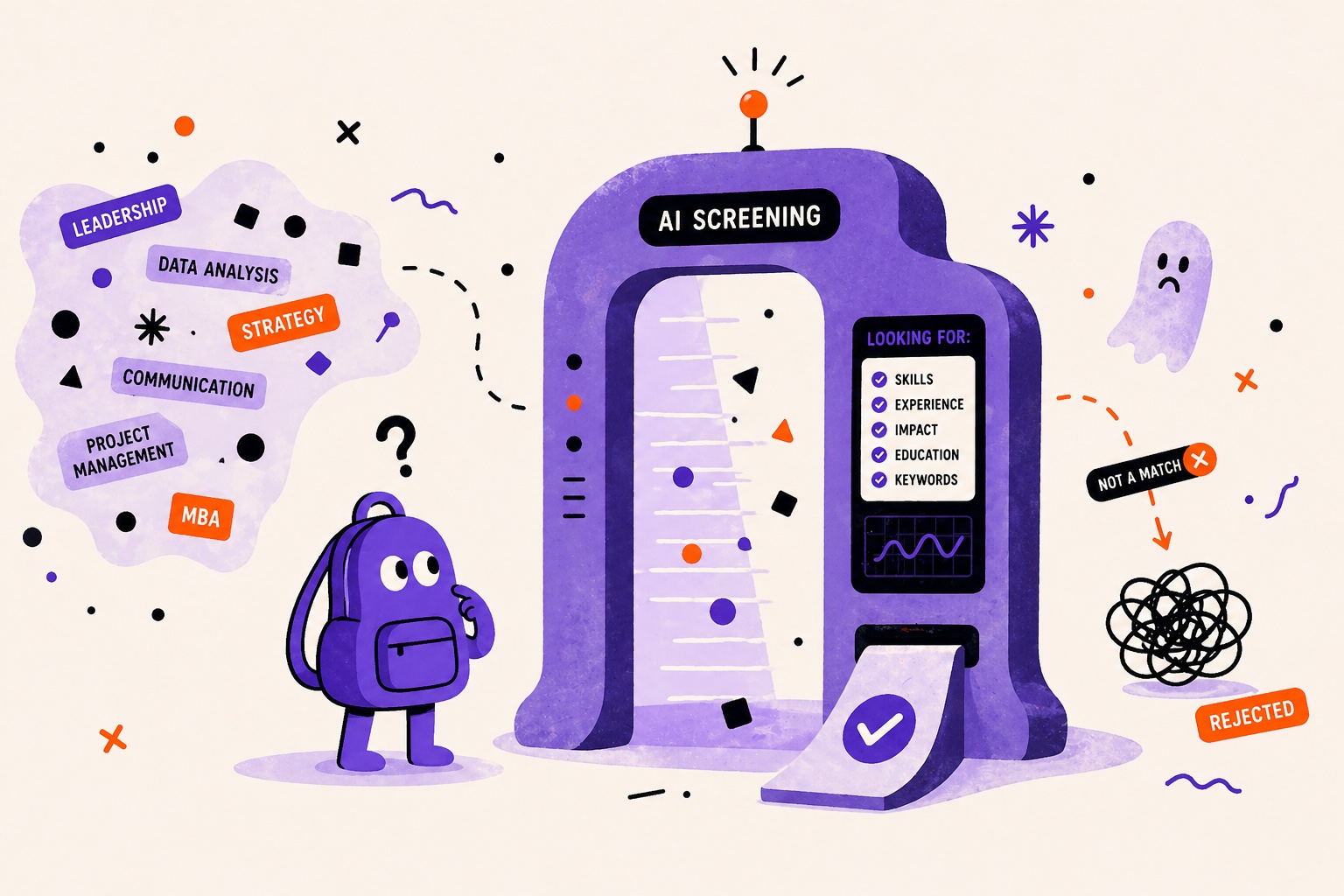
Here's a stat that might make you nervous: 62% of job seekers say they wouldn't apply to a company using AI in hiring decisions.
But here's the reality: AI is already screening resumes at Amazon, Unilever, Delta Air Lines, Siemens, Domino's, and Electrolux. It's not going away—it's expanding.
After diving deep into the latest 2026 HR Leader's Guide to Using AI in Recruiting and years of training materials, I'm going to tell you exactly what's happening behind the scenes. And honestly? It's not as scary as you think.
The Fear vs. Reality Gap
Let's start with the numbers that tell two very different stories.
The AI recruitment market: $661M in 2023 → projected $1.1B by 2030. About 1 in 4 organizations now use AI for HR activities, most adopting it within just the last 12 months.
What recruiters think:
- 62% are optimistic about AI's impact (LinkedIn Future of Recruiting Report 2024)
- 14% jump in recruiters adding AI skills to their profiles last year
- Top benefits cited: faster job descriptions (57%), automating tasks (45%), improved productivity (41%)
What candidates think:
- 62% would NOT apply to a company using AI (Pew Research Center, 2022)
- Major concerns about fairness and bias
- Fear of being "rejected by a robot"
But here's the twist: When candidates actually used AI tools in a simulated hiring process, 69% found them fast, efficient, and easy to use (study published in Computers in Human Behavior).
The gap? Fear of the unknown vs. actual experience.
What AI Actually Does (No Sci-Fi Nonsense)
Let's demystify this. Here's how companies are actually using AI right now—no Terminator scenarios, just practical tools.
1. Writing Job Descriptions
What it does: AI analyzes existing job postings to optimize language, remove biased terms, and create more engaging copy.
The verdict: Low risk, high value. According to HR training materials, this is one of the safest and most effective AI applications. 57% of recruiters say it makes the process faster and easier.
2. Screening Resumes (The Part Everyone Worries About)
What it does: Uses machine learning to analyze resumes for keywords, experience patterns, and qualifications. Basically keyword matching on steroids.
The critical note: Legal compliance still requires human oversight. As the 2026 HR Guide states: "In any multi-step talent acquisition process, it is essential to appoint an HR decision-maker at each step to either confirm the results, reject pieces of the results, or challenge the results."
The catch: AI can "perpetuate the bias inherent in historical data." If a company historically hired a certain type of person, the AI learns to favor that pattern—which is why bias audits are now legally required in many states.
3. Chatbots & Communication
What it does: Handles initial candidate questions, provides real-time updates, schedules interviews.
Real example: Delta Air Lines uses an AI chatbot to answer candidate queries and provide personalized feedback throughout the process.
The verdict: Generally helpful. Keeps candidates informed without overwhelming recruiters.
4. Video Interviews (Most Controversial)
What it does: Some platforms analyze your responses to standardized questions. Others attempt facial recognition or sentiment analysis.
The reality: Many employers are opting OUT of video AI due to strict regulations. Illinois requires explicit consent before recording. Maryland limits facial recognition use. New York City requires bias audits and candidate notices.
The verdict: High risk, questionable value. Expect this to remain heavily regulated.
5. Pre-Employment Assessments
What it does: AI-powered tests measure cognitive abilities, problem-solving skills, job-specific competencies.
Real example: Unilever uses a game-based assessment that analyzes candidate responses and correlates them with traits of high performers.
The requirement: Vendors must provide documentation proving their assessments actually predict job performance for that specific role.
Real Companies Using AI Right Now
This isn't hypothetical. Here's what major employers are actually doing:
- Amazon: AI helps applicants find the right positions and offers online assessments for flexibility
- Siemens: Analyzes candidate profiles, resumes, and assessments to identify suitable matches
- Domino's: Structures entire recruitment process with AI to minimize bias
- Electrolux: AI-powered platform provides job recommendations, auto-schedules interviews, conducts one-way interviews
The Legal Reality: You Actually Have Rights
The regulatory landscape is shifting fast. Here's what you need to know.
The numbers:
- 16 states have passed AI regulations
- 1,600% increase in state-level AI bills in the past year
- 400+ AI-related bills currently in progress
What companies MUST do:
- Disclosure: Tell you if AI is being used to evaluate candidates
- Bias audits: Conduct regular audits to ensure AI isn't discriminating
- Human oversight: Have actual humans review AI decisions at each step
- Consent: Get your permission before using AI for video interviews (in certain states)
The Mobley v. Workday case: A candidate applied to 100+ jobs through the Workday platform and was rejected by all—often during non-working hours, suggesting zero human involvement. The lawsuit was allowed to proceed, sending a clear message: companies can't fully automate hiring decisions.
As Dr. Charles Scherbaum (expert in employment litigation) states: "Most current AI regulations focus on situations in which steps in the hiring process are completely deferred to AI and have no human intervention or oversight."
5 Strategies to Get Past AI Screening
You don't need to "game" the system. You just need to speak its language while staying authentic.
Strategy #1: Optimize for Keywords (But Stay Human)
AI screens for job-related keywords. Here's how to do it right:
- Read the job description carefully—note exact phrases
- Naturally incorporate those phrases into your resume
- If they say "SaaS sales cycle management," don't just write "sold software"
- Use industry-standard terminology
Pro tip: Create a "Core Competencies" or "Skills" section where you can list keywords naturally without awkward phrasing.
Strategy #2: Format for Machines, Write for Humans
AI parsers prefer clean, standard formats:
- File type: PDF or .docx (avoid unusual formats)
- Font: Standard fonts like Arial, Calibri, Times New Roman
- Headers: Use standard section titles (Experience, Education, Skills—not "My Journey" or "Where I've Been")
- Avoid: Tables, text boxes, graphics, unusual layouts that confuse parsing
But remember: a human will eventually read this too. Don't sacrifice readability for optimization.
Strategy #3: Quantify Everything
AI loves measurable data. Humans do too.
- ❌ "Improved sales significantly"
- ✅ "Increased sales by 40% ($2M to $2.8M) in 18 months"
Use numbers, percentages, dollar amounts, timeframes. Be specific.
Strategy #4: Match "Must Have" Qualifications
AI typically screens for "must have" qualifications before "nice to haves."
- Identify the 3-5 absolute requirements from the job description
- Make sure these are clearly stated in the top third of your resume
- Don't make the AI hunt for them
- Use exact phrasing when possible
Strategy #5: Remember the Human at the End
Here's the most important thing: even with AI screening, a human makes the final decision.
- Optimize for AI to get through the gate
- Write for humans to get the interview
- Be authentic—AI can spot keyword stuffing
- Focus on demonstrating value, not just matching keywords
As the 2026 HR Guide notes: "While AI tools can help reduce human bias in hiring, they can also perpetuate the bias inherent in historical data." The human reviewer is there to catch what the AI misses.
The Candidate Perception Problem
Here's something companies need to know (and you should understand):
Research shows that when candidates believe they've been rejected by an AI tool, they doubt the fairness of the process more than if rejected by a human. Minority candidates are especially wary due to concerns about racial bias in algorithms.
What good companies do:
- Transparent communication about AI use
- Keep humans actively involved in all decisions
- Provide actual feedback to candidates
- Conduct regular bias audits and publish results
If a company is using AI responsibly, they shouldn't be hiding it.
The Bottom Line: AI is a Tool, Not a Replacement
The question isn't "Should companies use AI?" The question is "Are they using it responsibly?"
According to HR experts, the lowest-risk, highest-value AI applications are:
- Job descriptions: Faster, better, less biased JDs
- Candidate communications: Keeping you informed and engaged
- Workforce planning: Predicting turnover and skill gaps
The highest-risk applications? Fully automated screening with no human oversight and video analysis with facial recognition.
As the 2026 HR Guide states: "The question is not whether AI will transform recruiting processes—it already has."
Your job? Understand how it works, optimize accordingly, and stay authentic. AI is the new gatekeeper, but it's still just a gate. Get through it, and you'll talk to an actual human who makes the real decision.
Want to see which resume versions work best? Use Role Trackr to log every application with notes on which version you sent. Track response rates and optimize what gets you through the door. Because data beats guessing every time.