industry-insights
The Hiring Industry Raised $600M+ to Make Your Job Search Harder
By Joe Ham · April 14, 2026 · 5 min read
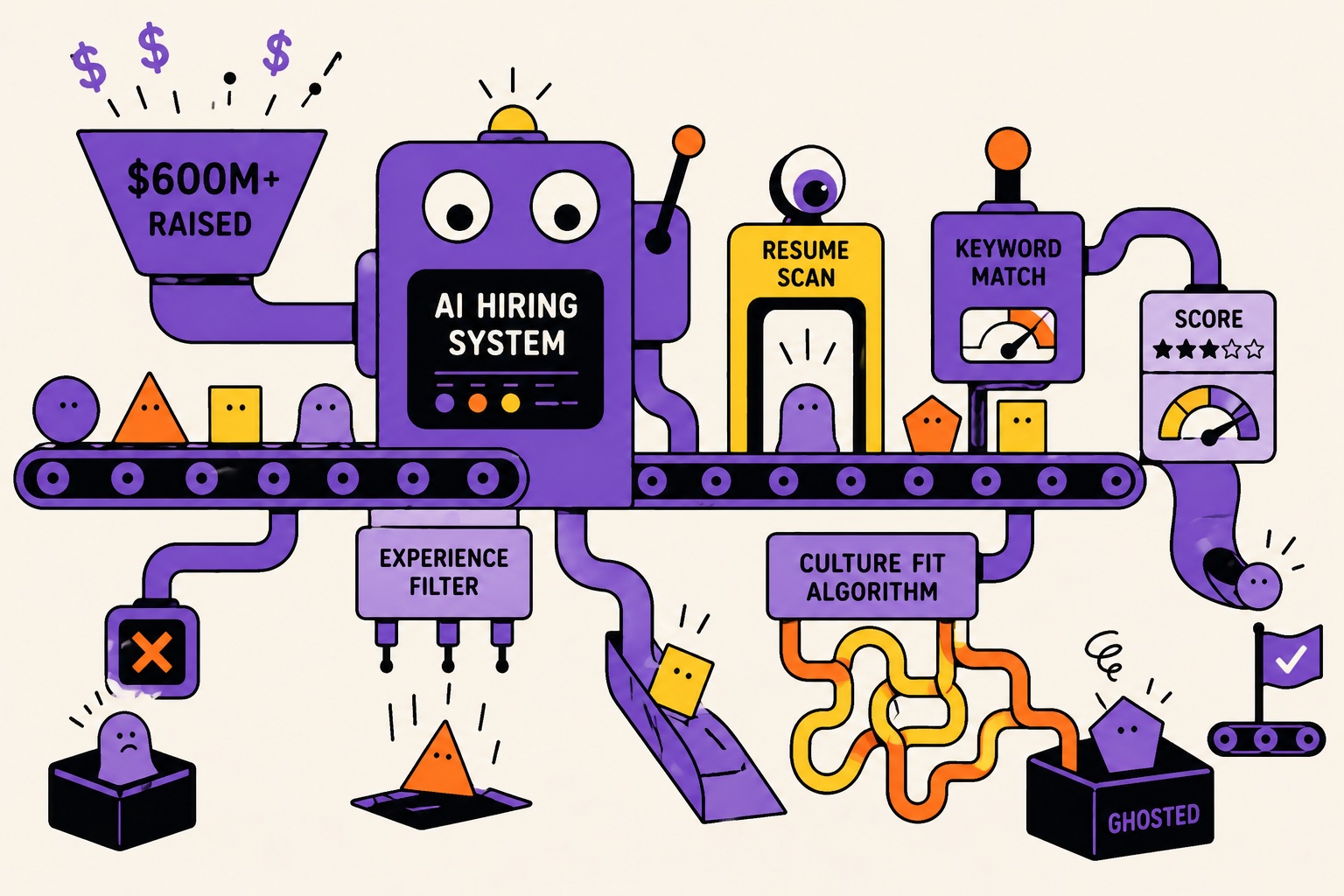
Almost none of it went to the people actually doing the job searching.
Before we dig in, this is not an anti-AI piece. At Role Trackr we use AI every day. This is about who the money is flowing to, what it is actually producing, and whether anyone is asking the right questions.
Where the Money Went
The recruiting technology space has seen an extraordinary flood of capital. Here is who raised what and what they are building:
- Mercor: Started as AI recruiting, pivoted to connecting domain experts with AI labs. $350M Series C (Oct 2025).
- Alex: AI that conducts your first-round interview before a human sees you. $20M Series A (Sept 2025).
- Juicebox: AI sourcing and candidate intelligence. $30M Series A (Sept 2025).
- Humanly: AI interviewing tools delivering pre-vetted candidates on demand. $25M Series B (Apr 2026).
- Ashby: Analytics-forward ATS. $50M Series D (2025).
- Perfect: Recruiter co-pilot for sourcing and triage. $23M Seed (Feb 2025).
- Jack & Jill: Free AI career agent for candidates plus an employer product. $20M (Oct 2025).
Notice anything about that list? Nearly every dollar is on the company side.
Jack & Jill is the only well-funded player with a genuine candidate-first thesis. Everything else is built to help companies process you faster.
What All That Investment Actually Built
Here is the dynamic it created, described as plainly as possible.
Companies built AI to screen thousands of applications. Candidates responded by using AI to send thousands of applications. Companies responded with stricter AI filters to detect AI-written resumes. Candidates responded with better AI to beat those filters.
The result? Bots screening resumes written by bots, with real people getting lost in the middle.
Nichol Bradford, SHRM's chief innovation officer, put it plainly: "The AI arms race does not benefit either side. Recruiters can't go through thousands of applications. Job seekers are demoralized to never hear from a human."
According to the 2025 SHRM Benchmarking Survey, cost-per-hire and time-to-hire have both gone UP during the three years of peak AI adoption. More technology. Worse outcomes.
Who Actually Gets Filtered Out
This is the part that does not make it into the press releases. These systems are not neutral.
A University of Washington study published November 2025 found AI systems prefer white-associated names 85% of the time. SHRM found that 19% of organizations using AI in hiring confirmed their tools screened out qualified candidates.
Think about who that represents in practice:
- The 50-year-old with 25 years of experience whose resume format predates ATS optimization. Flagged for the wrong keywords. Never seen.
- The person who freezes on camera. AI video tools score eye contact and vocal tone as proxies for confidence. Someone with social anxiety gets scored down before saying a word.
- The career changer. The person who took three years off to care for a parent. The candidate whose first language is not English.
They never make it to a human. Not because they were wrong for the role. Because the pattern did not match.
A Word About Recruiters
We want to say this clearly because it matters: we are not here to point fingers at recruiters.
Most of them are caught in the middle of this and they know it. They got into hiring to read people. To spot the unconventional candidate. To take a bet on someone who does not look perfect on paper.
That instinct is now being automated away right alongside the candidates they would have championed.
We want to work with recruiters, not around them. A candidate who shows up organized, researched, and intentional makes a recruiter's job easier at every stage. That is the bridge worth building.
Maybe This Is the Future
Maybe when the dust settles, AI hiring works better for everyone. But right now, here is what we keep seeing on the other side of the algorithm.
People are not asking for much. They just want a shot. They want to hear back. They want a little honesty. They want someone to look at them and say "we see you."
Maybe instead of pouring all the innovation into processing people faster, someone should be helping people show up better. Fewer applications. More intentional. Higher signal.
That is what we are building at Role Trackr. Not auto-apply. Not spray-and-pray. We call it manual automation: the organizational firepower of a full recruiting operation in the hands of the person doing the searching.
We Have Questions For Both Sides
Recruiters and hiring managers:
- Is this system actually working for you?
- What does a candidate do that genuinely gets your attention right now?
- If you could change one thing about how hiring works, what would it be?
Job seekers:
- What has been your worst experience with AI in the hiring process?
- Have you ever been rejected with no explanation and suspected a machine made the call?
- What would make this feel human again?
Drop your answers in the comments. We are building in public and we are genuinely reading every one.
Role Trackr is job search software built for candidates. Not companies. Not recruiters. You.