interview-tips
10 Red Flags That Instantly Disqualify You (From Years of Recruiter Training)
By Joe Ham · January 14, 2026 · 7 min read
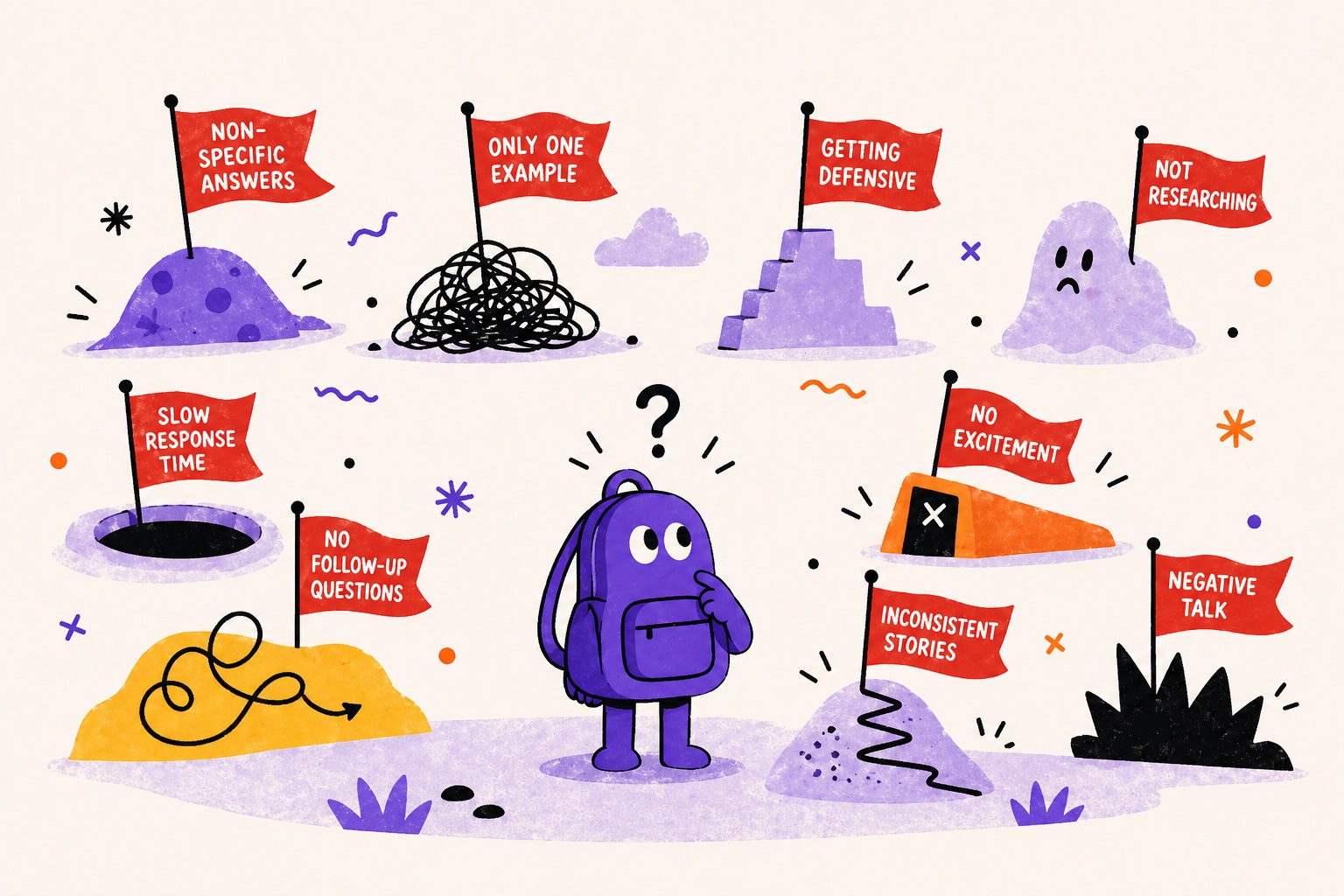
Here's something that might surprise you: the reasons you don't get the job are rarely what you think they are.
It's not your resume. It's not your years of experience. It's usually specific, invisible red flags that show up during the interview—things you probably don't even realize you're doing.
Over the years, I've collected recruiting training materials, hiring manager guides, and the actual scorecards companies use to evaluate candidates. I've studied what recruiters are trained to look for (and what immediately disqualifies someone).
Consider this your backstage pass. Here are the 10 invisible mistakes that take you out of consideration, and exactly how to fix them.
Red Flag #1: Non-Specific Answers
What it looks like: "Tell me about a time you overcame a challenge."
Your answer: "Well, I'm always overcoming challenges at work. I just stay positive and push through."
Why it kills your chances: Recruiters are listening for specifics—names, dates, concrete details. According to training materials, they're specifically looking for "recency, specifics, and passion." Vague answers = no proof you actually did what you claim.
The fix: Use the STAR Method (Situation, Task, Action, Result). Every story needs these four elements with actual details.
Example: "Last quarter, our main vendor failed to deliver critical parts for a $200K project. I personally called 23 backup suppliers, negotiated 48-hour shipping at cost, and coordinated with our team to restructure the timeline. We delivered only 3 days late instead of 3 weeks, and the client renewed for another year."
Red Flag #2: Having Only ONE Example
What it looks like: You nail the first question about "a time you showed leadership," but when they ask for another example, you freeze.
Why it matters: Here's a direct quote from internal recruiter training: "Everyone has ONE example. We're looking for 2-3. If someone truly has the trait, they will have MULTIPLE good examples."
The fix: Prepare three distinct examples for each core competency—grit, leadership, problem-solving, teamwork, coachability. Make them from different contexts (work, school, volunteer, side projects). Recruiters are looking for a history of behavior, not one lucky moment.
Red Flag #3: Getting Defensive
What it looks like: The interviewer challenges your answer or asks about a gap on your resume, and you immediately get defensive, make excuses, or blame others.
Why it matters: This is a coachability test. Training materials actually instruct interviewers to push back on weak answers to see if candidates "bounce back and give a better example or cave in." If you can't handle a tough interview question, how will you handle critical feedback from a manager?
The fix: Own your mistakes. In your stories, show what you learned. Say things like "Looking back, I should have..." or "That experience taught me..." Recruiters want resilience, not perfection.
Red Flag #4: The "I Just Need A Job" Vibe
What it looks like: Generic answers about why you want the role. No specific questions about the company. Clearly haven't looked past the job description.
Why it matters: Recruiters distinguish between "Relationship vs. Excitement." They can instantly tell if you just need any job versus genuinely wanting this specific job. Training materials list "Didn't do research" as a primary red flag.
The fix: Research deeply. Know their products, recent news, competitors, culture. Have 3-5 specific questions ready like "I saw you just launched X product—how is that changing the team's priorities?" or "I read your CEO's post about Y—how does that vision play out in this role?"
Red Flag #5: Slow Response Time
What it looks like: Taking 2-3 days to respond to scheduling emails. Not following up after interviews.
Why it matters: Speed = interest. Slow = "probably interviewing elsewhere and not that interested." The recruiter mantra from training materials is literally "Move FAST—no longer than 2 weeks" for the entire process.
The fix: Respond within 24 hours, even if it's just to acknowledge and say you'll provide details soon. Send a thank-you note within 24 hours of each interview. Match their pace.
Red Flag #6: No Follow-Up Questions
What it looks like: The interview wraps up, they ask if you have questions, and you say "Nope, I'm all good!"
Why it matters: Training materials note that recruiters look for candidates who ask questions "and not things they are able to find the answer to online." No questions = no curiosity = you're just going through the motions.
The fix: Always have 5-7 questions ready. Ask about team dynamics, biggest challenges, what success looks like in 90 days, how they measure performance, what they personally love about working there. Make it a conversation.
Red Flag #7: No Excitement About the Role
What it looks like: Low energy. Monotone answers. Looking bored or distracted.
Why it matters: According to LinkedIn data, 80-90% of talent say a positive or negative interview experience can change their mind about a role. The reverse is true for hiring managers—they're measuring your energy too. Training materials specifically look for: "Tone: Positive, enthusiastic, energetic."
The fix: Show enthusiasm through your voice, body language, and word choice. If you're interviewing for something you're genuinely excited about, let it show. If you're not excited, maybe this isn't the right role.
Red Flag #8: Inconsistencies in Your Story
What it looks like: Your timeline doesn't match your resume. You contradict yourself between the phone screen and final interview. The math doesn't add up.
Why it matters: This raises immediate honesty concerns. Multiple training documents list "Inconsistencies in answers" as a primary red flag that stops the process cold.
The fix: Be truthful. Keep your story straight across all interactions. If you made a mistake or misunderstood earlier, just own it: "Actually, I misspoke earlier—let me clarify..."
Red Flag #9: Can't Get to the Point
What it looks like: Five-minute answers to simple questions. Going off on tangents. Never quite answering what was actually asked.
Why it matters: Here's what training materials say: "This is also a 'coaching' test to see how well they apply instructions. If they don't answer directly, if they ramble on and on, it's a poor indicator of their ability to take and follow instructions."
The fix: Practice the "brief, specific, direct" formula. Training materials literally tell candidates: "The best way to answer: direct, with specifics, and with brevity. It's ok to pause before answering." Aim for 90-second answers.
Red Flag #10: Values Mismatch
What it looks like: Your examples highlight traits the company doesn't prioritize. You talk about loving independent work when they emphasize collaboration. You emphasize stability when they value risk-taking.
Why it matters: Training materials state that "The #1 goal of a great interview is to determine: Do they represent our Values and Virtues?" If your values don't align, you won't be happy there anyway.
The fix: Research their stated values (website, social media, Glassdoor, employee testimonials). Naturally weave those values into your examples. If you genuinely don't align with their values, that's valuable information—this might not be the right fit.
The Meta-Lesson: These Aren't Arbitrary
Here's the thing: these aren't random pet peeves. They're predictors of job performance.
Research from the U.S. Office of Personnel Management shows that structured interviews—where candidates answer the same questions evaluated against predetermined criteria—have both more reliability (different interviewers reach consistent conclusions) and more validity (they actually measure what matters).
As one training guide puts it: "If the hiring team is not even excited about a candidate during the interview process when they are putting their best foot forward, that bodes poorly for how the team will feel once the 'honeymoon' phase passes."
You can prepare for this. You now know what the scorecard looks like.
Quick Reference Checklist
- ✓ Prepare 3 examples per core skill using STAR method
- ✓ Research company until you can ask 5+ specific questions
- ✓ Respond to all communications within 24 hours
- ✓ Practice your energy/enthusiasm (yes, practice it)
- ✓ Keep your story straight and consistent
- ✓ Aim for 90-second answers: brief, specific, direct
- ✓ Ask questions that show genuine curiosity
- ✓ Match your examples to their stated values
Ready to never drop the ball on a dream role? Use Role Trackr to organize your applications, log interview notes, track follow-ups, and see exactly where each opportunity stands. Because the most organized candidate usually wins.